What We Do
Building an inclusive, competitive and resilient smallholder forestry sector.
In Tanzania, commercial wood plantations was considered to be the role of the government until in the late nineties when the government started creating enabling environment for private commercial forest plantations. Because of favourable climate and suitable soils as well as availability of land for expansion of tree farming, the Southern Highlands has attracted both private industrial forestry companies and smallholder tree growers.
To stimulate an inclusive forest sector, the Private Forestry and Carbon Trading Project (PF-CT) demonstrated the tree growers associations (TGA) model. PF-CT was a bilateral development cooperation project between the governments of Tanzania and Finland implemented in 2010–2012. Tree growers associations are voluntary groups formed by tree farmers at village level.
TGA members have come together for the purpose of having a collective voice in the forestry sector and its related value chains at local level, where members can increase their lobbying powers and negotiation skills in mutual matters, increase their market and price knowledge and improve their technical skills in the tree growing value chain from seeds to market.
The main objective of the TGA model is to increase smallholders' net income at harvest through enhancement of productivity and quality standards in tree farming by providing improved planting materials, technical advice and creation of an enabling environment. TGAs have taken the role of focal point for organising these services in their respective locations.
Smallholder tree growers often mention low levels of knowledge and technical capacity, aggravated by limited access to advisory services, improved seeds, recurrent wild fire and disorganised wood markets, as the four major barriers to becoming successful commercial forest actors.
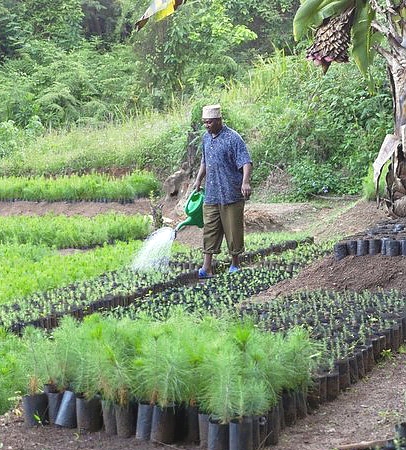
High prices of improved seedlings offered by commercial nursery operators — TZS 150 to TZS 200 per seedling — are explained by smallholders as a key hindrance to adopting improved planting materials. Under the TGA common nursery, tree growers get the same material at TZS 70. Members are given seedlings for planting one acre for free, and beyond that pay TZS 70 per seedling. Members mobilise their resources by contributing for the purchase of seeds, polythene tubes and labour for management of the nursery.
The growing importance of smallholder engagement in commercial forestry called for an apex body in the Southern Highlands: the Southern Highlands Tree Growers Association (SHTGA), formed in 2014 and registered in 2016. Members of SHTGA are TGAs from 8 districts located in Iringa, Njombe and Morogoro regions.
This led to the establishment of the Tanzania Tree Growers Associations Federation (TTGAF) in 2017, a central body bringing together private commercial smallholder tree growers for a collective voice. TTGAF's goal is to spur a common Tanzania smallholder tree growers voice in order to address forestry and related value chain issues, enhancing inclusivity, competitiveness and resilience of the sector.
Roles of SHTGA
- To advise TGAs on gender participation in tree planting
- To promote development of public-private partnership in the forest sector
- To enable members to share knowledge and experience
- To collaborate with private and public institutions in finding reliable markets for wood products
Sustainability
Members at the centre
Sustainability of TGAs, SHTGA and TTGAF largely depends on member satisfaction with the services provided as well as reducing dependence on donor support — services such as marketing of members’ wood, enhancing access to improved planting materials and farm inputs at reasonable prices, and provision of technical support in plantation management for improved income at harvest.